|
 |
|
| Field Day is June 28-29! ARRL Field Day is a celebration of everything that makes amateur radio special. It’s about camaraderie, learning, public service, and, yes, a little friendly competition. It’s our opportunity to demonstrate our emergency preparedness, reach out to the public, and inspire the next generation of hams. Most importantly, it’s a time to have fun and strengthen the bonds that make our clubs and our Sections so vibrant.
Field Day is the perfect time to practice emergency communications skills. Schedule training sessions on logging, message handling, and equipment setup. Review safety protocols for antennas, generators, and severe weather. A safe, well-organized event ensures everyone has a positive experience and is ready to respond when real emergencies arise. — Scott Roberts, KK4ECR, ARRL Northern Florida Section Manager
Want to learn more about foxhunting? Perhaps pick up a new strategy or two? Join Wayne Greene, KB4DSF, at the next “On the Air Live” interactive livestream on June 24 at 8 PM Eastern Time. Registration is open now! —Steve Goodgame, K5ATA, ARRL Education and Learning Manager
|
|
Utah ARES Conducts Statewide Simulated Emergency Test (SET) |
| On November 2, 2024, Utah ARES ran its first statewide Simulated Emergency Test (SET) in cooperation with three adjoining states. The exercise was done in partnership with a large hospital organization with critical operations across Utah and other states. The exercise was focused on the use of AREDN (Amateur Radio Emergency Data Network) mesh network connectivity and message handling capabilities. Voice and digital modes were used on HF. Starlink was also tested as a way to connect isolated AREDN networks.
Background
Utah ARES had previously agreed that the hospital organization would be a served agency, and this exercise was a natural extension of that agreement. County-level ARES groups in southern Utah had previously created AREDN mesh networks that had at least some coverage in five counties and were particularly strong in Washington County (with the largest population in southern Utah and a number of hospital facilities). This exercise expanded the geography to include Salt Lake County in northern Utah, home to over a third of Utah’s residents and many major hospital facilities.
Design
Clients at served agencies should not have to be fluent in radio operations. In order to make them most comfortable with amateur radio as a possible emergency solution, it was decided that ARES would integrate VoIP phones over mesh networks into this exercise. All prospective clients use desk phones in their command centers, and many surplus VoIP devices were available locally.
Mesh networks are a relatively new technology to Utah ARES. Research needed to be done to determine best locations for mesh nodes in specific geographic areas as well as exact capabilities of mesh networks regarding VoIP communications, large-file transfers, and chat messaging protocols. Connecting mesh networks over long distances using Starlink also needed additional research to determine best practices and capabilities.
This exercise was also designed to test the capabilities of individual radio operators in setting up and operating portable field stations using alternate power (battery, solar, etc.), Radio operators were required to erect an effective antenna system and connect their transceivers to alternate energy sources that were sufficient to power their individual stations for the duration of the exercise. The exercise also tested operators’ skills in message-handling in voice and data modes.
Field locations for this exercise were chosen at client sites that would have a critical need for mesh capabilities in the event of a communications emergency. Rooftop access was not feasible at any of the chosen locations in Salt Lake County, so all of these locations were ground-based.
Results
Portable mesh nodes: The location, setup and operation of portable mesh nodes was performed with partial success. ARES operators in southern Utah have more experience with this technology and had a greater level of success. Topography and node location/elevation were issues in Salt Lake County.
Integration of Starlink: Even though the Washington County Starlink terminal went down during the exercise, an operator used his personal Starlink unit to reestablish connectivity from the Washington County mesh to other mesh networks around the state. This was a successful outcome.
Communication/message handling: When nodes were able to connect, communications went well. Several VoIP phone calls were completed. All of the messages via VoIP were intelligible, although some contacts were marginal. Large data files (up to 46 MB) were transferred via FileZilla. Over 19 files were transferred in total.
Real-time videos were able to be viewed on the mesh network. Salt Lake, Garfield, and Washington Counties were all able to connect their respective mesh networks via Starlink. More than 50 chat messages were sent via different protocols on the mesh networks. No issues were noted when passing messages via HF Winlink using remote message servers. Over 25 messages were sent using this method.
Conclusions
Most participants agreed that gaining access to rooftops would be critical to deploy a reliable AREDN network in northern Utah’s challenging topography. Our partners expressed a willingness to make building rooftops available for future exercises. Additional exercises will be conducted to determine the maximum capabilities of the mesh network. Contacts: ARRL Utah Section Manager Brett Pruitt, K7BDP, Salt Lake County EC Paul Plack, AE4KR, and ARRL Utah PIC Scott Rosenbush, K7HSR.
|
 |
|
| Bob Vosper, KZ1B, Boyd Borden, K7OUF, Ric Wayman, K7DLX, and Jay Kay, K7SWU, at the Southern Utah Command Center. (Photo courtesy of ARRL Utah Section Manager Brett Pruitt, K7BDP) |
|
|
|
|
Expanding ARES Horizons with CERT and GMRS |
| Polk County, Florida, ARES has discovered a highly effective method for expanding our ranks and boosting amateur radio participation across the board: We have engaged our local Community Emergency Response Teams (CERT). By fostering collaboration and demonstrating the unique capabilities of amateur radio, we’ve tapped into a goldmine of enthusiastic new recruits.
Showcasing the advanced opportunities found in amateur radio, we’ve established a positive and mutually beneficial relationship with CERT groups that use the General Mobile Radio Service (GMRS). We actively invite them to our meetings and events, extending a hand of fellowship and demonstrating respect for the vital work they do. This approach has expanded our reach significantly; we now have a thousand more sets of eyes and ears than before. Many of us have obtained GMRS call signs, and our EOC has even installed a GMRS radio in the radio room. During Hurricane Milton, we successfully used both platforms to bring crucial information to our EOC, highlighting the value of this collaboration.
Why do CERT groups predominantly use GMRS? The answer is straightforward: the license fee is only $35, no tests are required, equipment costs are lower and the license covers the entire family. Recognizing this, our strategy is to highlight the capabilities of ham radio, showcase our exciting innovations, and attract them with demonstrations of the variety and enjoyment it offers. As a result, our membership numbers are growing, and meetings are energized by the enthusiasm of these new participants.
We established a net for GMRS users, teaching net protocols. Our next step involves training on incident reporting using the TEL method (Time, Event, Location) employed in our SKYWARN nets. Given the number of CERT teams in our area, we encourage each team to establish its own channel and consolidate reports from its members. A designated liaison from each CERT team then relays these reports to us on the GMRS frequency, enabling us to pass them on to the Emergency Manager for prioritization.
Working with area groups allows us to gather more information, presented in a usable format, during critical emergency situations when time is of the essence. Second, it exposes individuals familiar with radio communication and its community benefits to the potential of amateur radio. We aim to make ham radio seem both interesting and attainable, emphasizing its capabilities beyond those of GMRS. Our monthly “QRP in the Park” events play a key role in this effort. We’ve added a tailgate tech section, where experienced hams demonstrate the marvels of ham radio to new Technicians and GMRS users alike. Considering all the benefits ARES has gained by extending a hand of friendship and appreciation to our CERT teams and GMRS users, the effort has been well worth the reward. —Christine Duez, K4KJN, ARRL Public Information Coordinator, Polk County (Florida) ARES
|
 |
|
|
2025 CALLEJERO Exercise: Enhancing Community Preparedness Through Amateur Radio |
| Pasadena, California, June 2, 2025–The ARES LAX Northeast (LAXNORTHEAST) team recently concluded the highly successful CALLEJERO exercise, inspired by the Map Your Neighborhood (MYN) program, which emphasizes community-based disaster preparedness. This event aimed to strengthen situational awareness and communication skills among amateur radio operators in our region.
The CALLEJERO exercise, held on May 31, 2025, focused on building short and long-term situational awareness through Winlink communication using VARA FM on VHF/UHF. Participants exchanged Winlink forms, responded to polls, and updated their PinpointAPRS locations. This exercise drew inspiration from the MYN program, encouraging operators to survey local public resources and consider their neighbors in emergency planning.
Oliver Dully, K6OLI, the ARES District Emergency Coordinator for LAXNORTHEAST, stated, “During the Eaton Fire on January 7, 2025, we experienced first-hand the value and strengths of neighborhood cooperation and preparedness. The CALLEJERO exercise built on those experiences, encouraging our operators to map their local resources, integrate their neighbors in their preparedness plans, and work closely with their radio team. Working together we can pool situational awareness reports and build a timely common operating picture.”
The live CALLEJERO exercise saw 14 participants from Los Angeles County send 132 Winlink messages and share 122 resources in spreadsheet-based polls. Operators reported on the status of 59 (fictitious) neighbors with Site Polls.
Operators also submitted Local Weather Report, Severe Weather Report, Hurricane Report, Welfare Bulletin, Check-in, Check-out, ICS214 Activity Log, and After-Action Report Winlink forms. The exercise used the area system of repeaters on 70 centimeters and APRS with VARA FM on a 2-meter tactical frequency. Stations were encouraged to use any local Winlink gateway available to them.
Dully said, “We also welcomed exercise reports from 15 stations outside of LA County: in the United States, SDG ARES stations from San Diego County, as well as stations from Arizona, New Jersey, and Tennessee completed the exercise tasks and submitted reports.”
“We were pleased to have participation from international radio operators, including members of the German DARC Winlink Treff and the Austrian WLNET-OE,” Dully added. “Their involvement added a valuable global perspective to our exercise and built international goodwill.” Patrick Langer, OE1LHP, helped translate the exercise instructions into German and spread the word in Europe.
Feedback from operators highlighted the importance of location selection for reliable communication, the value of computer backups, and the significance of training and preparation. Overall, the CALLEJERO exercise was a valuable experience for all involved, enhancing our team’s preparedness and reinforcing the importance of community collaboration in emergency response. Read the exercise dashboard and documentation.
|
 |
|
|
Celebrating 90 Years of ARRL ARES® |
| As we celebrate 90 years of ARES, it is essential to reflect on its history, achievements, and the role it plays in emergency management. In 1935, ARES was established to organize amateur radio operators to provide communication support during emergencies. The initiative was born out of the need for reliable communication channels when traditional systems fail. Over the decades, ARES has evolved, adapting to new technologies and the changing landscape of emergency management. The first local emergency coordinators were appointed in 1937. They were Charles H. Taylor, W4B, in the Southeast; J. Robert St. Clair, W2B, in the Northeast; and Harry L. Miller, W5A, in the Southwest.
ARES has played a crucial role in numerous disaster responses, including hurricanes, floods, and wildfires. Amateur radio operators have provided essential communication links when other systems were down, ensuring that emergency services can coordinate effectively. Over the years, ARES has focused on training its members to be prepared for emergencies. This training includes regular nets, drills, participation in emergency preparedness exercises, and collaboration with local emergency management agencies. The training ensures that operators are ready to respond quickly and efficiently when called upon.
ARES has fostered strong relationships with local communities and emergency services. By participating in public service events and providing communication support for community activities, members have built trust and recognition as valuable resources in times of need. As technology has advanced, so has ARES, with the integration of digital modes, satellite communications, and other modern technologies that have enhanced the capabilities of amateur radio operators. This evolution allows ARES to provide even more reliable and efficient communication during emergencies. —QST NFL, ARRL Northern Florida Section newsletter
|
|
K1CE For a Final: Dayton ARES® Forum |
| It was a pleasure to attend the Dayton Hamvention’s ARES forum last month, with ARRL Director of Emergency Management Josh Johnston, KE5MHV, conducting. Good attendance and discourse were in evidence. Josh announced that the League’s Basic and Intermediate emcomm courses have been updated. A new ARES® TASK BOOK has been published, as of July 2024, and is NIMS compliant. A new ARRL ARES Plan document was also published. Johnston has filed recommendations with the Cybersecurity and Infrastructure Security Agency (CISA) for an advanced AUXCOMM course. He noted that last year was a busy one, with the May cyberattack on ARRL HQ operations, and major natural disasters: wildfires, floods and hurricanes.
Diversity was also in evidence last year, which saw the ARRL National Traffic System (NTS) handle many health and welfare messages. Additional modes such as SSTV and ATV also saw new activity. (Please see the July 2025 QST Public Service column for history and updates on research and development of amateur television use for ARES).
Johnston noted that we must take training seriously, and be always ready: Semper Paratus. He also urged positive attitudes on the part of ARES leadership: “Don’t turn emcomm operators off.”
He noted that contesters make good net control stations (NCS)—recruit them. Josh also recommended community outreach for coordination with GMRS and FRS radio operators, and especially Community Emergency Response Teams (CERT).
Johnston has been at ARRL HQ for several years now and has been a great asset for ARES. He brought to HQ his experience as a former professional county emergency manager in Arkansas. He recommends ARES members be ready, responsive, and resilient.
|
 |
|
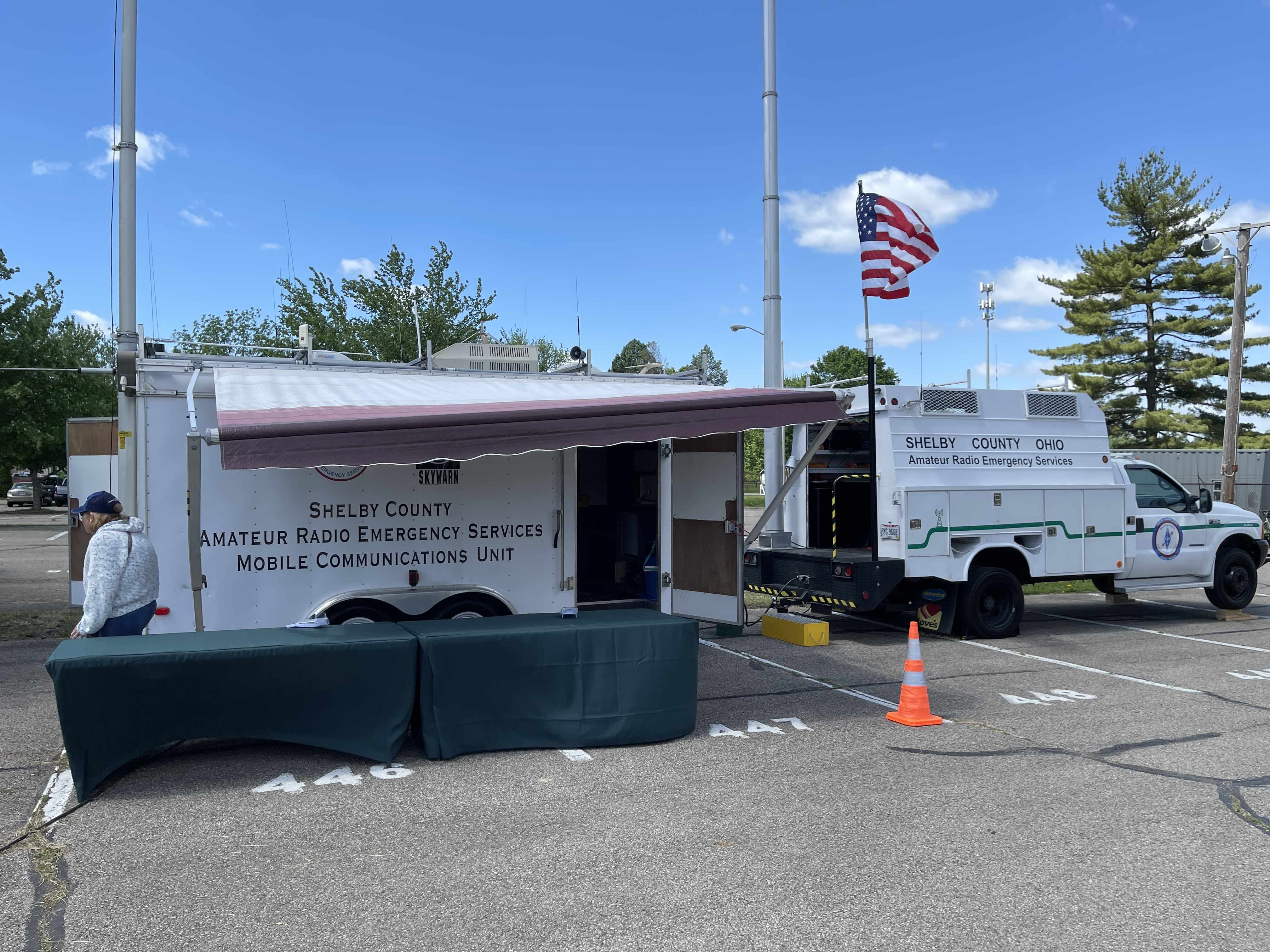
| Shelby County, Ohio, ARES mobile communications unit exhibited at the Dayton Hamvention last month. [K1CE photo] |
|
|
|
| Read the editorial on page 9 of the July 2025 issue of QST: ARRL CEO David Minster, NA2AA, discusses what “personal preparedness” means. The July issue is the annual emcomm issue, and there are a number of other emcomm-related articles that you won’t want to miss.
And last but not least, for a thrilling, easy read on a Sunday afternoon, check out 200 Meters and Down, by Clinton DeSoto, ARRL Secretary, 1936. It covers the early history of radio development by amateurs, and a great history of early emergency communications.
Buy 90 Years of ARES stickers!
|
 |
|
| The Amateur Radio Emergency Service® (ARES) consists of licensed amateurs who have voluntarily registered their qualifications and equipment with their local ARES leadership, for communications duty in the public service when disaster strikes. Every licensed amateur, regardless of membership in ARRL or any other local or national organization is eligible to apply for membership in ARES. Training may be required or desired to participate fully in ARES. Please inquire at the local level for specific information. Because ARES is an amateur radio program, only licensed radio amateurs are eligible for membership. The possession of emergency-powered equipment is desirable, but is not a requirement for membership.
How to Get Involved in ARES: Fill out the ARES Registration form and submit it to your local Emergency Coordinator.
|
| ARES® is a program of ARRL The National Association for Amateur Radio®. No other organization works harder than ARRL to promote and protect amateur radio! ARRL members enjoy many benefits and services including digital magazines, e-newsletters, online learning (learn.arrl.org), and technical support. Membership also supports programs for radio clubs, on-air contests, Logbook of The World®, ARRL Field Day, and the all-volunteer ARRL Field Organization.
Join ARRL or renew today! www.arrl.org/join
The ARES Letter is free of charge to ARRL members. Subscribe: www.arrl.org/subscribe
Find ARRL on Facebook, Instagram, YouTube, X (@arrl and @arrl_ares), and Threads
ARRL Store: www.arrl.org/shop
Support programs not funded by member dues at www.arrl.org/donate
Contact us to advertise in this newsletter (space subject to availability): ads@arrl.org
|
| The ARES Letter is published on the third Wednesday of each month. ARRL members may subscribe at no cost or unsubscribe by editing their Member Data Page at www.arrl.org/opt-in-out.
Copyright © 2025 American Radio Relay League, Incorporated. Use and distribution of this publication, or any portion thereof, is permitted for non-commercial or educational purposes, with attribution. All other purposes require written permission.
|
|
|
|
|
|
|
|